
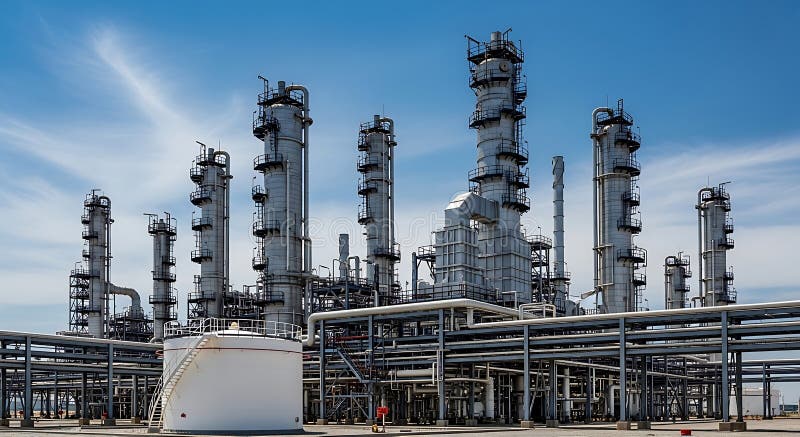
How sensitive an oil, gas or chemical site is to lightning is usually decided not by strike frequency but by consequence. The same -30 kA cloud-to-ground flash that means a repair ticket on an ordinary factory roof can mean shutdown, fire and a regulatory investigation when it lands on the rim seal of a floating-roof tank.
Why such sites get picked
- Tall structures are targets in themselves. Tanks, columns, stacks, flares and loading arms are each the highest point around.
- Flammable vapour is permanently present. Breather valves, gauge hatches, floating-roof seals and loading connections sit right at the edge of a hazardous atmosphere.
- Sites are isolated and open. Refining complexes, terminals and well pads usually sit outside urban areas with no taller structure to share the exposure.
Put the three together and the conclusion is straightforward: on these sites the question is not only how to route a strike once it happens, but how to stop it happening at all.
Four value points that actually count
Treated as a cost line, protection is argued in unit price. Treated as part of operational continuity, it is argued in value. On oil, gas and chemical sites the value falls into four buckets:
- Asset life. Rigs, tanks, piping, columns and instruments are high-value assets; one strike can trigger repair, inspection and lost production as three separate costs.
- Fire and explosion. Lightning is itself an ignition source, and these sites are never short of fuel. Lower strike probability is directly lower ignition probability.
- Operational continuity. A shutdown propagates along the supply chain; the loss usually exceeds the equipment value and reaches contracts and reputation.
- Data and communication. Modern plants depend on instrumentation, DCS and communications; induced overvoltage takes out data and links well before it takes out structures.
- Tank farm. Tank tops, breather valves, gauge hatches and floating-roof seals; devices placed between tank groups with coverage calculated from protection radius, and reliable bonding between tanks. This is covered in detail in tank farm and terminal protection.
- Loading area and loading arms. Vapour concentration peaks during transfer, and potential differences appear readily between arms, jetty and road tankers. Bonding and static discharge control belong alongside the device itself.
- Flares and tall towers. Continuous duty, highest position, difficult access — the classic case where the consequence is severe and detection is late. Suppression plus long-term monitoring suits these points.
- Control room and switchgear. The issue here is not a direct strike but surges entering on power and signal cables: staged SPDs and an equipotential bar.
- Earthing and bonding. Tanks, piping, loading arms, steel structures and the earth grid in one system, with spark gaps eliminated; measure earth resistance to the project requirement and keep the record.
- Staged surge protection. At main distribution, cabinet distribution and instrument ports, with the SPD voltage protection level matched to equipment tolerance.
- In-service records. Monitoring at key points turns "suspected strike" into an archived event for HSE, insurance and modification work.
Four areas, four priorities
The same technology lands differently by area. Splitting the site up makes the priorities clear:
Codes: compliance is the floor, not the objective
The code landscape is dense. IEC 62305 gives the overall framework; NFPA 780 and API RP 2003 carry specific clauses for flammable liquid tanks and static operations; domestically GB 50057 and hazardous-chemical lightning safety rules apply. Regulatory review is a gate every project must pass, but note that meeting the clause is not the same as minimising risk. Lay out air terminals to the letter and lightning still lands — it just lands along a compliant path.
If the objective is to reduce accident probability rather than to pass acceptance, then "do we let the strike form at all" should be on the table during design, instead of assuming interception is the only option.
Three things that must be done alongside
Ask for an area-by-area review
Send the site plan, tank and column heights, loading area positions, existing earth grid and the applicable code. We will return device positions and protection-radius calculations by area, with a model and quantity list. Submit your requirement here, or write to sales@malinsmarine.com.
Source: industry articles published on the Futurewa site (futurewa.com). This page is a rewritten summary with engineering commentary added, for technical reference.